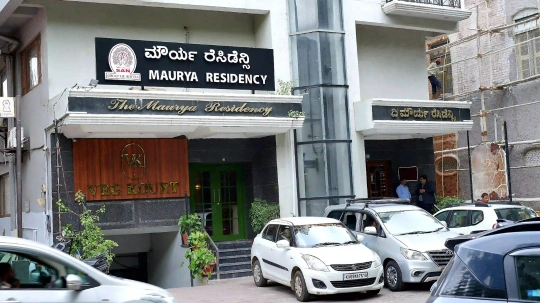
You’ve got three tabs open. The same room shows ₹2,100 on one app, ₹1,950 on another behind a coupon that expires in eleven minutes, and the property’s own number sits on the third tab. Most people take the coupon. It’s a reasonable instinct and it’s usually the wrong one, because direct hotel booking in Mysore can get you more than the ₹50 the app just saved. Maurya Palace and Maurya Residency give travellers another option to consider when comparing rates, room categories and booking requirements, while Maurya Palace and Maurya Residency can also help guests understand what is included with their stay.
The gap isn’t only in the headline rate. It shows up in which room you’re actually given, whether the extra bed costs anything, how a delayed train gets handled, and what happens when you want to leave at 2 pm instead of 11 am.
An aggregator sits between you and the property and takes a cut of the room rate, typically somewhere between 15 and 25 percent depending on the contract. That commission has to come from somewhere. Either the property raises its listed rate to absorb it, or it protects its margin by putting app bookings in the least desirable rooms.
Neither is a conspiracy. It’s arithmetic. With direct hotel booking in Mysore, that margin is available to be spent on you instead, which is why a property can often match the app price and still throw in breakfast or a later checkout.
The interesting question isn’t whether you save money. It’s what form the saving takes.
On a ₹2,000 room, a property that keeps its full margin has ₹300 to ₹500 of room to move. Sometimes that arrives as a lower rate. More often it arrives as something the app cannot sell you: a corner room, a free extra mattress for a child, or breakfast for two included. For a three-night stay, that stack is worth more than any coupon.
If a property is running at ninety percent occupancy during Dasara, there is no margin to give away and no reason to discount. Direct hotel booking in Mysore during peak weeks buys you availability and room choice, not a lower price. Expect that, and you won’t be disappointed.
Apps sell a room category. A phone call sells a stay. Any hotel booking in Mysore involves half a dozen details that never appear in a booking form, and these are the ones that only come up in conversation:
• Early check-in when you’re arriving on an overnight bus at 6 am
• Late checkout, particularly useful if your return train leaves in the evening
• A quiet room away from the road or the lift shaft
• Extra bed or mattress charges, and child occupancy policy
• Free parking confirmation for a car with a roof carrier
• Breakfast included rather than billed
Very few of those show up as options during online hotel booking Mysore travellers do at midnight. All of them are ordinary requests when you’re speaking to the person who assigns the rooms.
Two rooms in the same property, same category, same tariff, can be wildly different. One faces the internal courtyard and gets morning light. The other looks onto a service lane and sits under the water tank.
Apps have no field for this. Direct hotel booking in Mysore lets you say “upper floor, away from the road, please” and have it noted against your name. Whether you get it depends on how full the property is, but a request made at booking has a far better chance than one made at the desk at 11 pm.
Plans change, particularly on family trips. Aggregator cancellation terms are automated and unforgiving, and refunds move through a payment gateway on their own schedule.
This is the least discussed benefit of direct hotel booking in Mysore. A property you booked with directly can usually shift your dates with a phone call, especially if you’re moving the booking rather than cancelling it outright. The same applies to arrival time. If your train from Bengaluru is running two hours late, one message keeps the room. An app booking marked no-show at midnight is a much harder conversation the next morning.
Being honest about this matters. Apps are genuinely better at three things:
The sensible method is to use the app for the shortlist and the phone for the booking. Search, compare, pick two properties, then call both. That’s how experienced travellers approach Mysore hotel booking without giving up either convenience or value.
Headline rates hide too much. Compare the total cost for your actual group, not per-night display price.
|
Factor |
Booked through an app |
Booked directly |
|
Headline rate |
Often marginally lower |
Matched or close |
|
Breakfast |
Usually extra |
Frequently negotiable |
|
Extra bed for a child |
Fixed charge if offered |
Often waived or reduced |
|
Room choice |
Allocated on arrival |
Requestable at booking |
|
Late checkout |
Rarely available |
Usually possible off-season |
|
Date change |
Policy-driven, often penalised |
Handled case by case |
|
Late arrival |
Risk of no-show cancellation |
Held with a phone call |
Real hotel deals in Mysore are rarely the flashing banner ones. They’re the ₹1,900 room that includes breakfast for two and a free extra mattress, which a family of four will feel far more than a ₹100 coupon. Run that comparison once and the case for direct hotel booking in Mysore stops being an argument about loyalty and becomes simple arithmetic.
In this order, it takes about fifteen minutes:
Properties that answer within an hour with clear numbers tend to run tidy operations.
No. During Dasara, long weekends and the December holiday stretch, rates hold firm everywhere and there’s little room to negotiate. What direct hotel booking in Mysore reliably gives you in those weeks is room choice, flexibility on arrival time, and a real person to call if plans shift.
Somewhere between five and fifteen percent in total value on an off-season stay, counting inclusions rather than just the rate. On a three-night family booking that’s often ₹800 to ₹2,000 once breakfast and an extra bed are factored in. These figures are indicative and depend on occupancy and season.
A small advance is normal during peak dates, and most properties accept UPI transfers. Ask for a written confirmation with your name, dates, room type and total tariff before paying. If a property asks for the full amount upfront for an ordinary weekday hotel booking in Mysore, treat that as unusual.
Absolutely, and you should. Use the app for the shortlist and location check, then call. Comparing online first gives you a benchmark rate. Most people who book hotel in Mysore this way end up paying app-level prices for better rooms, which is the whole point of a Mysore hotel booking done properly.
The value in direct hotel booking in Mysore isn’t a secret discount code. It’s the fifteen minutes you spend talking to someone who can discuss your room requirements, note your arrival time, and explain whether a child’s extra mattress is chargeable. Apps are excellent at showing you what exists. They’re less suited to handling the specifics of how you actually travel. Use both, in that order, and you can compare a better overall stay rather than focusing only on the displayed rate.
If you’re considering a stay at Maurya Palace and Maurya Residency, contact the team with your travel dates, number of guests and preferred room type. They can help you understand the available options, inclusions and booking requirements before you confirm your reservation.
For Mysuru travel inspiration, practical booking advice and hotel updates, follow us on Instagram and keep up with useful ideas for your next visit.